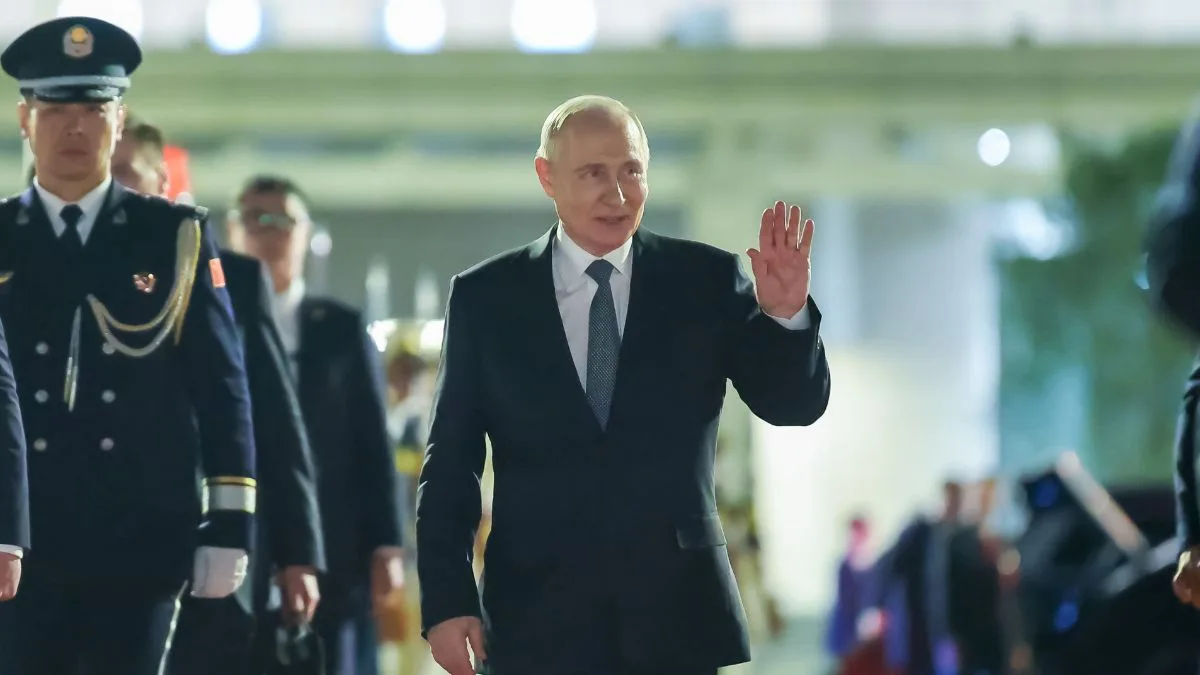
Russian President Vladimir Putin on Thursday said Moscow remained open to ending the war in Ukraine through diplomacy, but insisted that any settlement would require concessions from Kyiv, even as he claimed Russian forces were continuing to make gains on the battlefield.
Speaking to foreign media editors on the sidelines of Russia’s flagship economic forum in St Petersburg, Putin said proposals discussed with US President Donald Trump could pave the way for peace if Ukraine was willing to accept the compromises Moscow has long demanded.
Advertisement
The remarks came at a moment when diplomatic signals from both sides appeared to intensify. Ukrainian President Volodymyr Zelensky published an open letter proposing a direct meeting with Putin to discuss ending the conflict, while Trump publicly backed the idea of a face-to-face engagement between the two leaders.
Putin, however, made clear that Russia sees little reason to slow its military campaign while it believes it holds the advantage. He argued that manpower, industrial capacity and political resolve were working in Moscow’s favour and said Russian troops were advancing every day.
“The offensive is ongoing on a daily basis,” Putin said.
According to the Russian leader, “at present, the Russian Federation has taken full control of the Luhansk People’s Republic — 100%. And Russia has brought over 85% of the territory of the Donetsk People’s Republic under its control. (And) 80% of the territory of the Zaporizhzhia region”, reported Reuters. Russia annexed the territories in 2022, a move rejected by Ukraine and most Western nations.
Putin said Ukraine’s desire to halt Russia’s advance could instead be addressed through a negotiated settlement.
“Rather than stopping that, it would be better to bring the war to an end altogether by agreeing to the compromises that were discussed in Anchorage,” he said, referring to discussions held during a summit with Trump in Alaska last year.
Putin reiterates demand for compromise
While Putin did not spell out the exact terms again, his comments appeared to reference Moscow’s longstanding demand that Ukraine surrender the remainder of the Donbas region. Kyiv has consistently rejected such proposals, arguing they would weaken the country and expose it to future attacks.
Putin said Russia remained ready to conclude the conflict through peaceful means and claimed he had conveyed that position to Trump.
“We are certainly prepared and willing to reach an agreement with Ukraine through peaceful means,” he said.
He added that any agreement would require both sides to accept the compromises discussed during his talks with the US president.
Zelensky pushes for direct talks
In his open letter, Zelensky suggested that a direct meeting between the two leaders could help break the deadlock. He argued that Russia was facing growing domestic pressures, including inflation, fuel shortages and continued Ukrainian drone and missile strikes.
The Ukrainian leader also suggested that Putin’s political future could depend on decisions made now regarding the war.
The Kremlin said Putin was aware of the letter but had not yet studied its contents in detail.
Trump, meanwhile, welcomed the prospect of a meeting between the Russian and Ukrainian leaders.
Warning on hypersonic missile
Putin also used the interaction with foreign journalists to issue a warning about Russia’s military capabilities.
He said Moscow had not yet deployed its Oreshnik hypersonic missile against Ukraine in real combat conditions and had so far limited its use to testing and evaluation.
The nuclear-capable missile, first unveiled in operations against Ukraine in 2024, has a reported range exceeding 5,000 kilometres. Putin has previously described it as impossible to intercept, although Western analysts have disputed that claim.
Putin avoids talk of post-2030 future
Asked about his political future, Putin declined to discuss whether he would seek another presidential term after 2030.
Russia’s Constitution allows him to run again and potentially remain in office until 2036, but Putin said it was too early to focus on that question.
“The country faces a lot of large-scale and pressing issues,” he said. “They need to be solved while thinking about the future of Russia.”